Find the Nest
Trace trails and inspect damp wood, wall voids, trees, and stumps to locate the colony.
Pest Education • DFW Pest Control
Carpenter ants don't eat wood the way termites do — they hollow it out to nest, and they go after wood that moisture has already softened. Finding them is often the tip-off that you have a leak somewhere. Here are the signs and how control actually works.
Reviewed and updated June 2026
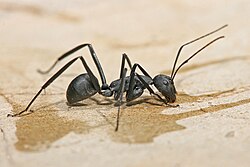
Carpenter ants carve smooth galleries through damp or damaged wood to build their nest. You solve it by locating the nest, fixing the moisture that drew them, and baiting the colony — not by killing the few workers you spot on the counter.
Carpenter ants are among the largest ants found around Texas homes. They are usually black, sometimes with reddish tones, and workers vary in size within a single colony.
Unlike termites, carpenter ants do not eat wood. They tunnel through it to build smooth nesting galleries, pushing out the debris as a fine, sawdust-like material called frass.
Carpenter ants prefer wood that is already damp or decaying, so their presence often points to a moisture problem such as a leak, poor drainage, or condensation.
Spraying trailing ants does not address the colony, which may be inside a wall or in a tree or stump outdoors. Effective control finds and treats the nest and removes the moisture that attracted them.
Trace trails and inspect damp wood, wall voids, trees, and stumps to locate the colony.
Correct the moisture source and use baits that reach the nest, not just contact spray.
Explore services →Seal entry points and keep wood dry so colonies cannot re-establish.
Request an estimate →Treatments are selected and applied per their labels. Tell us about children, pets, edible gardens, beehives, and other sensitive areas before service, and follow all preparation and re-entry instructions. More on pet- and pollinator-conscious treatment →
They are usually slower and less destructive than subterranean termites, but a long-established colony can still cause meaningful damage, especially in chronically damp wood.
Often, yes. They favor wood softened by moisture, so indoor carpenter ants frequently point to a leak, drainage issue, or condensation worth investigating.
Spraying the workers you see leaves the nest intact. Baiting and treating the actual nest, plus fixing the moisture, is what resolves the problem.
Guidance changes over time. Follow current product labels and local recommendations. This page is educational and is not medical advice.
Call or email for a free estimate. We’ll recommend an approach that fits your property.